This week I was experimenting with dyeing with lac. So far, all the natural dyes I’ve used have been of plant origin. But there are a number of natural dyes derived from animal sources – vegans, look away here! The most famous are probably cochineal, widely used as a food dye (made from crushed-up South American scale insects…) and sepia, made from the ink of an octopus or cuttlefish. Another red dye derived from scale insects is lac, which comes from India, Southeast Asia, Nepal and China. The lac insects secrete a resinous pigment onto sticks of a host tree, which are then cut and harvested. Lac is used in shellac and lacquer as a protective coating, but a deep red colorant can also be extracted from it. Think of the rich red robes of a Tibetan or Nepalese Buddhist monk. They were dyed with lac.
Lac has been used as a natural dye for hundreds of years but fortunately nowadays we don’t have to farm our own scale insects. I bought mine as a small jar of gritty powder which I had to dissolve in water with citric acid before straining off.

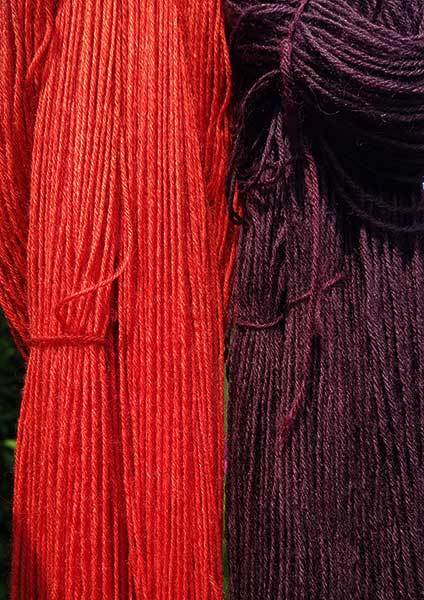
I dyed two skeins of yarn, and modified one after dyeing with an iron solution, which turned the red to a blackened purple. It was interesting to compare the red obtained from lac with the madder I had tried before. The madder gave a more orange, brick red, whereas the lac gave that deep, warmer Tibetan monk red.
I’m delighted with these two additions to my yarn basket. Who would have thought something so pretty could come from bug secretions?